Galaxy Office Automation

Galaxy Office Automation Pvt Ltd Drives Performance and Efficiency with EBS Volumes for EXFO

About the Company

Galaxy Office Automation Pvt Ltd Drives
Performance and Efficiency with EBS Volumes for EXFO Electro-Optical Engineering India Pvt Ltd

The Challenge

EXFO’s rapidly growing business and data-intensive workloads demanded high-performance storage solutions. Their existing traditional storage infrastructure was struggling to keep up, leading to performance bottlenecks and operational inefficiencies.

The Solution

Galaxy Office Automation Pvt Ltd, recommended and implemented Amazon Elastic Block Store (EBS) volumes as EXFO’s primary storage solution.

How Galaxy Successfully Solved the Company’s Challenges

  • Galaxy Team conducted a thorough assessment of EXFO’s IT environment, storage requirements, and performance needs.
  • Based on the findings, Galaxy Team proposed a migration plan to move EXFO’s critical data and applications to EBS volumes, optimized for their specific workload demands.
  • Galaxy Team experienced engineers seamlessly migrated EXFO’s data to EBS, minimizing downtime and disruption to their operations.

  • Enhanced Performance: EBS volumes delivered significant performance improvements, reducing application response times by up to 50%. EXFO’s engineers and data analysts experienced faster data access and retrieval, boosting their productivity.
  • Increased Scalability and Flexibility: EBS volumes easily scaled to accommodate EXFO’s growing data volume, eliminating the need for frequent hardware upgrades. With EBS, EXFO could provision new storage on-demand, providing agility and flexibility to adapt to changing business needs.
  • Improved Cost Efficiency: EBS pay-per-use model eliminated upfront capital expenditures and ongoing maintenance costs associated with traditional storage solutions. EXFO only paid for the storage they used, leading to significant cost savings.
  • Enhanced Data Availability and Reliability: EBS volumes offer high availability and redundancy features, ensuring EXFO’s critical data is always accessible and protected against hardware failures.
  • Simplified Management: EBS simplifies storage management with an intuitive web interface. EXFO’s IT team gained centralized control over storage provisioning, monitoring, and scaling, reducing administrative overhead.

Benefits

  • High IOPS and throughput: EBS volumes come in various types, each offering different IOPS (Input/Output Operations Per Second) and throughput levels. You can choose the type that best suits your application’s performance needs, ensuring consistent and fast data access. For instance, Provisioned IOPS SSD volumes deliver ultra-low latency for mission-critical applications, while General Purpose SSD volumes offer a balance of performance and cost for everyday workloads.
  • Elastic scalability: EBS volumes can be easily scaled up or down in size on the fly, without downtime or data loss. This allows you to adapt your storage capacity to your evolving needs, eliminating the need for over-provisioning and associated costs.

Overall, EBS volumes offer a compelling solution for primary storage, providing a combination of high performance, scalability, reliability, cost-effectiveness, security, and flexibility. Whether you’re running mission-critical applications or everyday workloads, EBS can help you optimize your storage infrastructure and achieve your business objectives.

This case study showcases how Galaxy Office Automation Pvt Ltd, as a trusted AWS partner, helped EXFO unlock the potential of EBS volumes to optimize their storage infrastructure and achieve significant performance, scalability, and cost benefits. EBS proved to be a perfect fit for EXFO’s demanding workloads, paving the way for their continued success in the telecommunications industry.

“Galaxy Office Automation’s expertise in AWS and their efficient migration process made our transition to EBS volumes seamless and painless. EBS has transformed our storage infrastructure, providing us with the performance, scalability, and cost-efficiency we need to support our continued growth”

IT Manager

EXFO India Pvt Ltd
To know more about the solution

Galaxy Office Automation Helps Media Company Optimize S3 Storage for AWS Account

About the Company

Galaxy Office Automation Pvt Ltd Implements
Commvault Backup for Epic Channel

As Epic Channel data needs grew, relying solely on on-premises backup became impractical. Galaxy Office Automation, leveraging their Commvault expertise, proposed a hybrid solution utilizing Commvault in conjunction with AWS

The Challenge

Epic Channel’s growing business and critical data necessitated a robust and reliable backup solution. Their existing system was manual, time-consuming, and prone to errors.

The Solution

Galaxy Office Automation Pvt Ltd, a Commvault AWS certified partner, recommended and implemented Commvault Complete Backup & Recovery solution.

How Galaxy Successfully Solved the Company’s Challenges

  • Galaxy OA conducted a thorough needs assessment to understand Epic Channel’s data environment, backup requirements, and recovery time objectives (RTOs).
  • Commvault Complete Backup & Recovery was deployed seamlessly, integrating with Epic Channel’s existing infrastructure and applications.
  • Galaxy OA trained Epic Channel’s IT staff on Commvault’s user-friendly interface and best practices for data backup and recovery.
  • Streamlined data protection: Commvault automated Epic Channel’s backup processes, eliminating manual tasks and minimizing errors.
  • Enhanced data security: Commvault’s multi-layered security features, including encryption and access controls, safeguard Epic Channel’s sensitive data.
  • Improved data availability: Commvault’s granular recovery capabilities allow Epic Channel to quickly restore individual files, folders, or entire systems, minimizing downtime and data loss.
  • Scalability and flexibility: Commvault scales easily to accommodate Epic Channel’s future data growth and evolving needs.
  • Reduced IT costs: Commvault’s centralized management and automation saved Epic Channel time and resources, lowering IT operational costs.

Benefits

  • Enhanced Data Security: Commvault’s multi-layered security features, including encryption, access controls, and audit trails, safeguard Epic Channel’s data both on-premises and in the cloud.
  • Improved Scalability and Flexibility: The hybrid architecture allows Epic Channel to easily scale their backup capacity and adapt to changing data needs, both on-premises and in the cloud.
  • Reduced Costs: Utilizing cost-effective AWS storage classes and Commvault’s efficient data management features, Epic Channel achieved significant cost savings compared to traditional on-premises backup solutions.
  • Faster Recovery Times: Granular recovery capabilities within Commvault allow Epic Channel to quickly restore individual files, folders, or entire systems, minimizing downtime and data loss.
  • Increased Business Continuity: With backups securely stored in AWS, Epic Channel gained access to disaster recovery capabilities, ensuring business continuity even in the event of on-premises infrastructure failures.

This case study demonstrates how Galaxy Office Automation Pvt Ltd, a Commvault’s helped Epic Channel achieve its data protection goals by implementing Commvault Complete Backup & Recovery. Commvault’s robust features, scalability, and ease of use make it an ideal solution for businesses of all sizes looking to protect their critical data and ensure business continuity.

“Galaxy Office Automation’s expertise in Commvault and their efficient implementation process were instrumental in our successful backup upgrade. Commvault has given us peace of mind knowing our critical data is safe and readily available”

IT Manager

Epic Channel

To know more about the solution

11 Types of Social Engineering Attacks

11 Types of Social Engineering Attacks

Using deception and manipulation, social engineering attacks induce the target into doing something that an attacker wants. The social engineer may use trickery, coercion, or other means to influence their target.

The Social Engineering Threat

A popular conception of cyberattacks is that they involve a hacker identifying and exploiting a vulnerability in an organization’s systems. This enables them to access sensitive data, plant malware, or take other malicious actions. While these types of attacks are frequent, a more common threat is social engineering. In general, it is easier to trick a person into taking a particular action — such as entering their login credentials into a phishing page — than it is to achieve the same objective through other means.

11 Types of Social Engineering Attacks

Cyber threat actors can use social engineering techniques in various ways to achieve their goals. Some examples of common social engineering attacks include the following:

  1. Phishing: Phishing involves sending messages designed to trick or coerce the target into performing some action. For example, phishing emails often include a link to a phishing webpage or an attachment that infects the user’s computer with malware. Spear phishing attacks are a type of phishing that targets an individual or small group.
  2. Business Email Compromise (BEC): In a BEC attack, the attacker masquerades as an executive within the organization. The attacker then instructs an employee to perform a wire transfer sending money to the attacker.
  3. Invoice Fraud: In some cases, cybercriminals may impersonate a vendor or supplier to steal money from the organization. The attacker sends over a fake invoice that, when paid, sends money to the attacker.
  4. Brand Impersonation: Brand impersonation is a common technique in social engineering attacks. For example, phishers may pretend to be from a major brand (DHL, LinkedIn, etc.) and trick the target into logging into their account on a phishing page, providing the attacker with the user’s credentials.
  5. Whaling: Whaling attacks are basically spear phishing attacks that target high-level employees within an organization. Executives and upper-level management have the power to authorize actions that benefit an attacker.
  6. Baiting: Baiting attacks use a free or desirable pretext to attract the interest of the target, prompting them to hand over login credentials or take other actions. For example, tempting targets with free music or discounts on premium software.
  7. Vishing: Vishing or “voice phishing” is a form of social engineering that is performed over the phone. It uses similar tricks and techniques to phishing but a different medium.
  8. Smishing: Smishing is phishing performed over SMS text messages. With the growing use of smartphones and link-shortening services, smishing is becoming a more common threat.
  9. Pretexting: Pretexting involves the attacker creating a fake scenario in which it would be logical for the target to send money or hand over sensitive information to the attacker. For example, the attacker may claim to be a trusted party who needs information to verify the victim’s identity.
  10. Quid Pro Quo: In a quid pro quo attack, the attacker gives the target something – such as money or a service – in exchange for valuable information.
  11. Tailgating/Piggybacking: Tailgating and piggybacking are social engineering techniques used to gain access to secure areas. The social engineer follows someone through a door with or without their knowledge. For example, an employee may hold a door for someone struggling with a heavy package.

How to Prevent Social Engineering Attacks

Social engineering targets an organization’s employees rather than weaknesses in its systems. Some of the ways that an organization can protect against social engineering attacks include:

  • Employee Education: Social engineering attacks are designed to trick the intended target. Training employees to identify and properly respond to common social engineering techniques helps to reduce the risk that they will fall for them.
  • Least PrivilegeSocial engineering attacks usually target user credentials, which can be used in follow-on attacks. Restricting the access that users have limits the damage that can be done with these credentials.
  • Separation of Duties: Responsibility for critical processes, such as wire transfers, should be divided between multiple parties. This ensures that no single employee can be tricked or coerced into performing these actions by an attacker.
  • Anti-Phishing Solutions: Phishing is the most common form of social engineering. Anti-phishing solutions such as email scanning can help to identify and block malicious emails from reaching users’ inboxes.
  • Multi-Factor Authentication (MFA): MFA makes it more difficult for an attacker to use credentials compromised by social engineering. In addition to a password, the attacker would also require access to the other MFA factor.
  • Endpoint Security: Social engineering is commonly used to deliver malware to target systems. Endpoint security solutions can limit the negative impacts of a successful phishing attack by identifying and remediating malware infections.

Author: Jeremy Fuchs 

Source: https://www.avanan.com/blog/11-types-of-social-engineering-attacks

FOR A FREE CONSULTATION, PLEASE CONTACT US.

Cyber Resilience: 5 Core Elements Of A Mature Cyber Recovery Program

CYBER RESILIENCE: 5 CORE ELEMENTS OF A MATURE CYBER RECOVERY PROGRAM

Cyber resilience is the result of business, security, and IT coming together to develop an integrated strategy and roadmap that aligns cyber security and business continuity. Its goal is to transform business expectations and guarantee the business less than significant impact from a cyber-attack.

To achieve this, organizations need to invest in developing and maturing a recovery program that can be reliably called upon it to bring back their business in the event of an attack.

5 ELEMENTS OF CYBER RECOVERY PROGRAM MATURITY AND ACHIEVING INCREMENTAL OUTCOMES

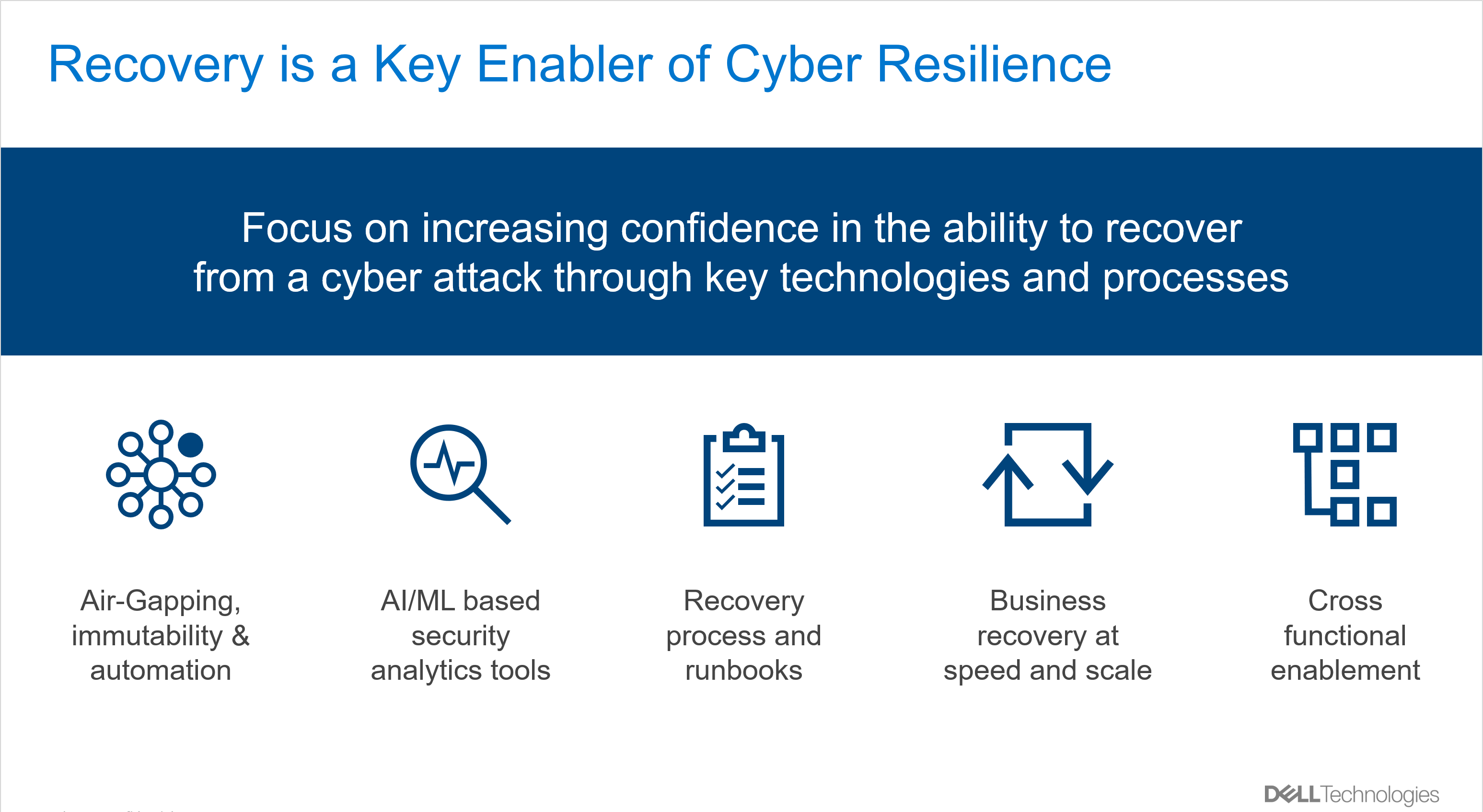
1. Organizations need to utilize technology purpose-built for recovering from a cyber-attack. The latest cyber recovery technologies are designed to address common threat vectors and create an effective cyber vault to protect enterprise data by creating isolation and additional hardening features, such as air-gapping and immutable storage, alongside automation to maintain process integrity and minimal user intervention.

2. Modern malware is a major challenge for organizations due to its sophisticated nature and intent to remain inconspicuous allowing the hackers to go unnoticed until they are ready to strike with force and cause widespread damage. They are known to leverage zero-day vulnerabilities to access and spread the infection, because its signature is not known, and it easily bypasses the traditional security defenses. Continuously analyzing data and analyze behavioral patterns using AI/ML based security analytics tools increases the likelihood of finding indicators of compromise and take proactive action to neutralize the infection before an attack is launched.

3. Developing a recovery processes is critical in operationalizing cyber recovery technologies and being ready for a recovery effort. This process must be tied tightly to recovering the most critical data first and should be documented in a runbook to ensure repeatability. Without careful planning and runbooks, most organizations may not survive a major interruption to the operation of their business, regardless of how mature their technology implementations are. Developing a recovery runbook also acts as a forcing function to identify gaps in current recovery process, people and skills.

4. To deliver business recovery at speed and scale, it’s imperative to mature the cyber recovery program of the organization, tightly aligning recovery procedures with the criticality of specific business processes or application to normal business operations. This enables the core functions of the business to get back up and running as quickly as possible. This is usually a challenging effort because it relies on a deeper understanding of interdependencies of applications and respective data, configuration management and availability of infrastructure resources. While individual application recovery is achievable through runbooks, we find that incorporating an automation strategy is critical for mass recovery. In the case of cyber it is especially important due to the iterative nature of recovery which includes initial recovery, performing forensics and damage assessment and remediation before data can be returned to production.

5. Full cross-functional enablement of the recovery capability further integrates with organization-wide incident response plans and ensures complete adoption and readiness to execute a recovery. Security and business continuity are a shared responsibility and during widespread cyber-attack where applications, network, systems data are compromised, it requires a cross-functional organization to participate in the recovery efforts.


We’re also seeing many customers interested in having some of their cyber resilience initiatives managed for them to reduce risk and improve security operations. A centralized security operation streamlines threat intelligence, detection and response services. In addition to providing 24×7 operations, MSSPs have a wider view of global cyber threats landscape and bring unique insights. Organizations can redirect their resources that have deep institutional knowledge to high value business recovery operations while the provider can help with incident response, coordination and infrastructure recovery.

Integration of these critical technologies and processes enable organizations build their cyber resilience by knowing they have a “last line of defense” and can recover, should they fall victim to an attack.

HOW TO START A CYBER RECOVERY STRATEGY:

There are a few different activities which are great places to start in building your recovery strategy. One is to conduct a current state analysis to establish a baseline and determine areas to invest in. There are a few ways to achieve this, which include a program maturity analysis or a Business Impact Analysis. Both provide different analyses but will help identify specific activities to prioritize.

Another great place to start is with a well-known industry framework to ensure you’re properly evaluating and designing your cyber recovery plans. The NIST Cybersecurity Framework is one that’s been chosen by many organizations because its holistic view and in-depth recommendations.

Author: Arun Krishnamoorthy, Global Strategy Lead for Resiliency and Security, Dell Technologies

Source: https://www.dell.com/en-us/blog/cyber-resilience-5-core-elements-of-a-mature-cyber-recovery-program/

FOR A FREE CONSULTATION, PLEASE CONTACT US

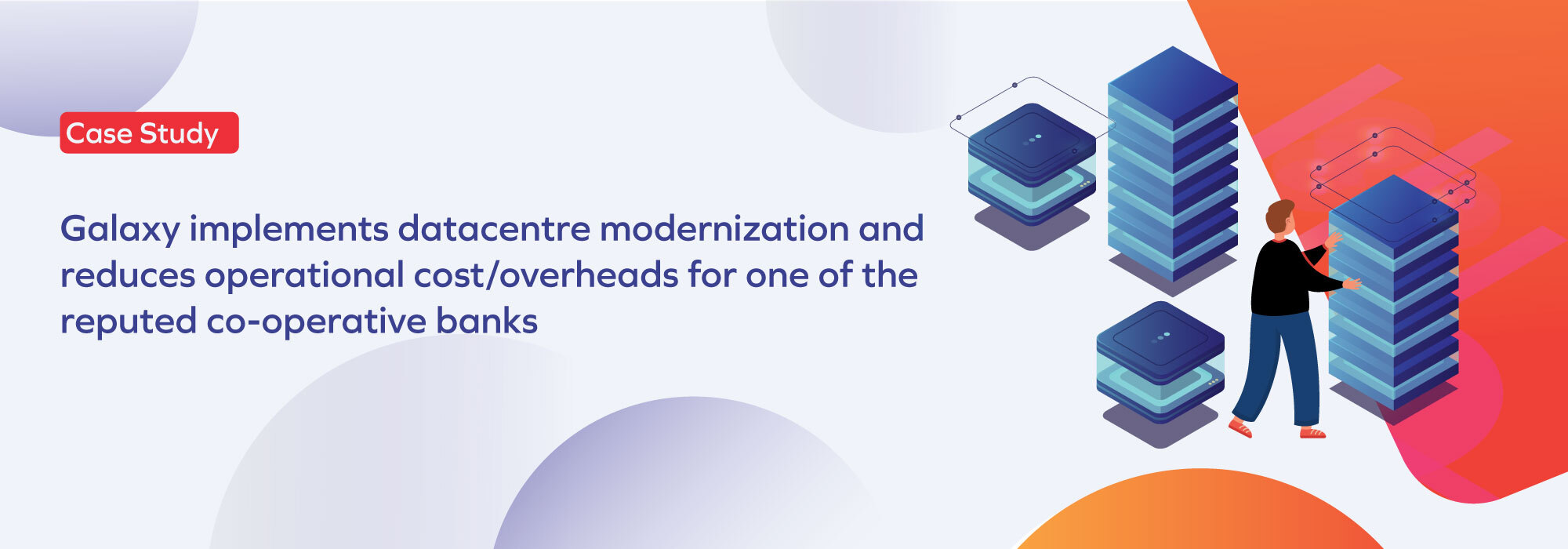
Co-operative Bank reduces its operational costs by implementing Datacenter Modernisation

The Challenge

This cooperative bank not only have 58 branches, but also boasts of having its own data center. Given the sensitive nature of its business, it was very important for the bank to maximize the uptime of its core banking applications and lower the RPO and RTO in the eventuality of a disaster.

Some of the other challenges were as follows:


  • The equipment at the bank’s data center i.e., storage, networking, and servers, was aging and posed a security risk to the bank. It was due for a tech refresh
  • The anti-virus solution was outdated and needed to be upgraded
  • There was a lack of structured cabling, hence troubleshooting time was very high.
  • Backups were done manually with no automated backup facility. There was an urgent need for an automated backup solution
  • Non-existence of a Disaster Recovery (DR) site
  • The firewall rules were not properly configured, which made them prone to a cyberattack
  • Inadequate Business Continuity Planning (BCP)

The Solution

The bank’s evaluation criteria for the selection of a suitable vendor for tech modernization were stringent.  It wanted solutions vendors who were established, and well-known in the market. Competitively priced, the vendors needed to have experience in HCI and the necessary prowess in providing cutting-edge tech services. Sustainability and present market share was also factored in while shortlisting the vendor. The technical team was insistent on the selection of a vendor that had previously implemented the HCI solution for at least two customers in the banking sector. A detailed technical presentation was required from the SIs before they could submit their commercial tenders. A decision was taken in favor of an HCI solution, moving from the erstwhile 3-tier architecture. The reasons for this were many — easy operation, high performance, flexibility in maintenance, and working from a single pane of glass (compute, storage, and network).

The Benefits

Galaxy provided consulting services to the bank to help modernize its data center and its operations with the latest cutting-edge technologies to achieve its IT and financial goals. Highly skilled teams were provided for networking, operations, and security..

Some of the main benefits accruing from the new solution and highlighted by the bank are:

  1. Lenovo Nutanix helped achieve a highly available and scalable compute and storage solution
  2. Bank applications are now protected with local backup copies and secondary DR replicated copy
  3. One-click DR operations (applications can run from the DR Site in no time)
  4. High security with core and perimeter firewall
  5. Improved performance of the applications with the help of an application load balancer
  6. Secured web applications with WAF
  7. Structure network cabling which helps to identify issues quickly
  8. Reduced data center management operational cost
  9. The potential of achieving the ROI within three years
  10. Reduced incidences of an outage with a better customer experience
  11. Reduced time to the market owing to single-click application flow
  12. Better security compliance with this new next-generation setup

To know more about the solution

Freight & Parcel Services simplified their IT operations by implementing Enterprise Storage Solution

The Challenge

With around 20000+ employees in more than 200 countries, a leading courier service company was facing many challenges with the data storage. Their main challenge was Storage tower of User Data. Due to so many employees, using their individual laptops and desktops there was huge amount of data deduplications, which was difficult to manage.

Another challenge for them was that there was no central Shared Storage system in the organization for collaborative sharing of data, which lead them to make multiple copies of data. There was also no mechanism of backing up user data at one particular place. Another concern for IT department was Manageability of data, since there was no centralized solution for storing user data, employees were taking backs up there on laptops, and security of that data was at stake. They started looking for a complete solution, which give solution to all their pain points and can be easily manageable.

The Solution

Galaxy suggested EMC Enterprise EMC Unified Storage with Replication Software to them. They also considered EMC Solution over others, as EMC has been market leaders in Storage Solution with its world class always ON backend support online. Enterprise Class storage with No single point of Failure and local protection of Data using Snaps/Clones for efficient backup, which fulfilled the customer challenges of central consolidated storage with replication to other regions as a backup solution.

“What differentiates EMC from its competition is not only the company depth of technology offerings but also knowledge and ability of its people.” Says IT Head of the courier company.

Galaxy team faced challenges while binding the storage with Active Directory, as there were some permission, which needed Head Office approvals. In the end project of central storage with backup at major location is achieved, along with backup replicated among them.

The Benefits

Productivity improvement: Since the implementation of central shared storage each department have their own folders to save their data which was shared amongst department users leading to effective collaboration and information sharing while reducing deduplicated copies of data.

Ensured business continuity: The solution was designed with replication of Tier1 cities data, while every location data was replicated ensuring additional backup copy ensuring business continuity.

User friendly – easy to use: Proposed solution provides an easy self-explanatory wizard based option to self-configure the system functions with monitoring tools with dashboard by which IT administrator could easily manage and monitor the Storage system.

Backup Solution: Local Protection Suite as part of solution enable administrator to take point in time copies of the data which is used as backup copies and replicated to other storage systems providing time stamps to help rollback in case of restoration of data.

High availability: EMC Storage is built with no single point of failure ensuring no downtime and 24x7availability. Using EMC Remote Protection Suite the replication of data provided.

To know more about the solution

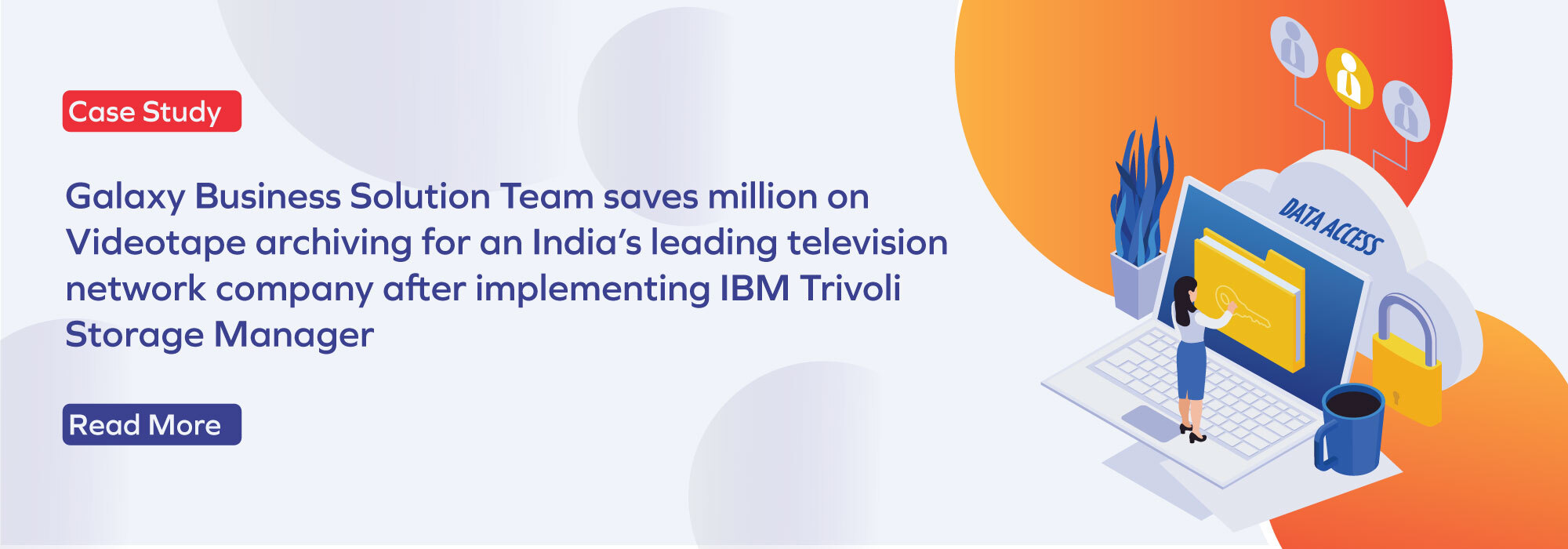
A leading television network company saved millions on videotape archiving by implementing IBM Trivoli Storage Manager

The Challenge

The media company faced major storage and data management challenges caused by a large volume of legacy content and the adoption of file-based workflows, with a significant amount of content being delivered as XDCAM, ProRes and RED files. As space on the company’s shared storage platform quickly ran out, it became critical to find a high performance LTO LTFS archiving solution to help manage the massive amounts of file-based content.

“It was clear, we needed an efficient and intelligent archiving solution to help us lower storage costs,” said IT Head. “However, we also needed to address the increasing difficulty our users’ encountered finding content, as no central search mechanism existed.”

The Solution

The leading television network company recognized the coming challenges of archiving HD content, and turned to IBM and IBM Business Partner Galaxy Office Automation for a state-of-the-art digital storage and archive system to handle HD programming.

To meet the increased data handling demands of high definition television (HDTV), the company needed to increase storage dramatically and improve its archive and retrieval capabilities while lowering costs.

The Company installed IBM Tivoli Storage Manager for direct-to-digital storage solution for HD video that eliminated the need for costly videotape recorders and media. The solution not only saved considerable amounts of money and physical space, it also offered a much more efficient way to handle video. This makes it possible to locate and retrieve clips quickly and enhances company’s ability to distribute programming.

The Benefits

Lowes OPEX cost: With IBM TMS, the company could save more than 70 percent of cost on storage media. It helps controlling storage management costs with ease-of-use features and integration with IBM network attached storage (NAS) products


Easy Backup system: The tape backups scheduling was done in IBM TMS software. In this the files were automatic compressed and is stored in backup tapes on the scheduled dates. This helped them in reducing a lot of manual work and thus saved the cost on work force.


High Availability: IBM TMS improves business continuity by shortening backup and recovery times and maximizing application availability with advanced data recovery management technologies. It also employ data de-duplication and a hierarchy of storage to increase efficiencies and conserve resources. Thus, it makes archived HD content available on demand.


Easy to use: Tivoli Storage Manager is a true enterprise product, and as such, can be configured many different ways to meet an organization’s needs.


Backup on any kind of media: IBM Tivoli Storage Manager can manage backup and archive data across disk arrays, tape libraries, or optical storage and can automatically move data as it ages to lower performance storage.

To know more about the solution

Financial Company secures crucial data by implementing Airwatch Solution

The Challenge

For the financial industry, security is a top priority. Especially for banking institutions, financial records and portfolio decisions hold sensitive information that must be safeguarded. Mobile devices provide the ideal platform for the bank to deliver its mission of providing top tier banking services, while drawing in a new generation of tech-savvy clients.

The leading bank introduced a new application to make the Account Opening Process with ease. This application is carried by every account opening executive throughout INDIA. The bank was concerned about securing the sensitive information stored on the devices by the executives for opening the new accounts and were also concerned about the security and confidentiality of the email service provided to the bank officials.

The bank’s IT security team came up with decision to bring Enterprise Mobility Management (EMM)solutions and started evaluating EMM solutions with various vendors.

The Solution

The Bank looked at a number of EMM providers before selecting AirWatch® by VMware® with Galaxy involved as a partner. After extensive research, the bank’s IT Security team found AirWatch® to be the best option as Enterprise Mobility Solution, combining security and an easy to use management console. We helped the customer’s IT team to understand how AirWatch will help the bank in mitigating their problem and how the use of AirWatch can benefit the bank.

The company was impressed by the extensive application controlling policies than other vendors, which was crucial for the bank.

AirWatch allows simplicity to maintain tighter controls and more effectively manage their mobile device. With AirWatch, the bank had control over company-owned mobile devices completely along with personal devices that is bring your own device (BYOD). The company counts on AirWatch’s flexible policy deployment options to manage devices and remain compliant without hindering employee’s ability to use their devices to the fullest extent.

Galaxy team implemented and deployed the solution in the bank’s environment. Additionally, the company was impressed with the responsiveness and customer support provided by the Galaxy team.

The Benefits

With the help of Galaxy, the leading financial company used the feature of secure launcher for securing their corporate owned Android device with banking application pushed centrally on the device. Galaxy team helped the client in securing the bank officials emails by using AirWatch Inbox, which secured and containerized the bank official’s email providing complete separation of enterprise and personal data. The other advantages that company ripped from the solutions were:

  • The bank achieved device level security.
  • Bank was able to protect the secure information.
  • The policy control for corporate owned devices and BYOD helped manage the bank with ease.
  • They were able to enhance the security features of their banking applications.
  • Containerization of emails in AirWatch Inbox helped them securing the confidential documents and emails on mobile devices.
 

To know more about the solution

Automobile manufacturing company implemented a high-speed network environment

The Project

The company started a new plant at Dharwad. In this new site, the IT department undertook to install and implement state-of-the-art technology to cater to the company’s growth path in the coming years. The IT team worked on a migration plan to transition its legacy cabling network and consequently charted out superior network requirements to provide for a reliable and high-speed network environment in the factory which would connect and run the main office, design studio, manufacturing units, shops etc.

Admin Building, TCF Shop, BIW Shop, Engine Shop, Paint Shop, Oil & Paint Store, LCV Shop, and Frame Line are the main constructions in the campus; apart from these more than 20 small individual buildings.

A server room was planned in the TCF Shop, which was directly connect to all the main locations through fiber backbone. The small buildings were also connected through fiber either from the Admin Building or from the Oil & Paint Stores. Accordingly, they designed the location of Hub Rooms calculating the maximum work area utilization as per telecommunication standards.

The IT team decided that to design a network on this scale they had to meet the following criteria:

  • A scalable and reliable network.
  • Optimised bandwidth connectivity for the smooth functioning of the system, several customized and complex computer applications, CCTV operations and voice communications.
  • Green environment sustainability and energy savings.
  • Lowest total cost of ownership.
  • Automated processes for administration and security.

In short, a redundant, fail-proof system had to be developed, along with a cabling system that would enable future upgrades. This seemed to be a challenge, as the campus infrastructure was already established and functioning on its full strength. Full-scale production was on and many hurdles seemed imminent. It was very important that this task be carried out in a very short time frame without affecting the normal functioning of the production processes.

Galaxy was chosen after careful assessment of its product portfolio. Galaxy worked with the company and the installation company to ensure a seamless execution of the project, throughout which they were able to achieve 100% network uptime. This consultative approach is a good example of how the company prefers to work with its customers.

Project Plan / Schedule

A detailed project schedule had been prepared in coordination with the company’s IT Team including deliveries, implementation, testing, commissioning, and handover of the project. The first phase was scheduled for 6 months, which included Admin office, TCF Shop, Engine Shop, BIW Shop, and Entry/Exit gates. Full project was completed in one and a half years.

  • Installation: Total 7000 meters overhead pathways was installed for entire project and used more than 20000 meters 12 core SM fiber cable with more than 1500 fiber splices. Along with this, 2000 Data nodes were installed, for installing 80000 meters approx. CAT 6 data cable used. Other than this, 50 NW Racks (42U, 32U, 15U, 9U) were installed in entire campus. For Active part, mounting, patching, Labeling of 78 switches installed out of which 4 nos C 4510 Series Cores switches were used at TCF, BIW & Engine Shops; 12 nos C 3750 Series switches were used at all main locations and C 2960 Series Edge switches all over.
  • Delivery Schedule: All the materials were delivered at site as per the delivery schedule so that the progress of work never affected.
  • Manpower: Galaxy deployed a team of 8 skilled technicians under a site supervisor for the project. The supervisor was responsible for arranging daily work permits, ensuring safety procedures and all communication/coordination within the plant authorities. A team of other 6 skilled employees were also deployed for the installation of Pathways; hence it was completely mechanical fabrication works including welding, fitting, threading etc.
  • Safety: The site is practicing strict safety measures especially for overhead works. Compulsory safety harnesses were allotted to all team members including safety shoes, jackets, helmets, gloves, safety belts etc. Even it was difficult to get permission in the productive areas, we managed to complete the works during non-productive hours.
  • Work Procedure:Galaxy complete the pathways first in all the shops; hence, it was the pre-requisite for cabling inside the shop floors. Meanwhile the fiber backbone cabling for the campus outside the shops was in progress. Client’s Civil Engineering team provided the raceways and Chambers by digging for backbone cabling.
  • Testing & Commissioning: End to end Fiber cores and Copper UTP nodes were tested with Fluke DTX Cable Analyzer before connecting to the computers and other equipment’s. All the Fiber and copper were successfully passed in the tests and the reports were generated in the testing equipment. In the end, IT In-charge of the manufacturing company concluded: “We were impressed by Galaxy’s close attention to detail and efficiency to roll out our network to time and to budget. It is good to know that they are just a phone call away when we require assistance. We are confident that we have invested in an infrastructure that will ensure that we can maintain our reputation as a leading automobile manufacturing company in India.” He further added, “This has been a lengthy installation using the latest technology products. We have been very pleased with the levels of service and support that we have received from Galaxy and the installed performance of the cabling solution, which has been tested and warranted for best performance.”

To know more about the solution

Leading financial company executed smooth Datacenter Migration

The Challenge

Migration of all systems and Data with minimal downtime from one datacenter.

Client lacked the expertise and experience to conduct a migration of this size internally.

Existing Production Data Centre existed in its current state, lacking standardization, efficiencies & growth scalability & unable to meet end to end level objectives.

Existing Production center had obsolete facilities infrastructure either in terms of high power consumption, a large chuck of legacy / unsupported equipments, or poor availability benchmarks.

Setup Details

Mumbai (Site-A): VMAX with 40TB(Production)


PUNE (Site-C): VMAX with 40TB (DR)


MAHAPE (Site-B): New site to be setup (New Production)

The Solution

Asset Management.

Multi-Phased Migration

Project and Vendor Management

System Design and Installation

Storage Design and Migration

Relocation of existing Production(FORT, Mumbai) to new DC (MAHAPE, Mumbai)

The Result

Successful Migration, test and turn up.

Project completed on schedule and within budget

Significant operational cost savings

Zero unscheduled downtime of systems

A highly available and redundant systems architecture

Migrated 26TB data across datacentres from dissimilar storage subsystems and cutover to new storage at new datacentre with zero data loss

Migrated 94 servers comprising of Wintel and Unix across datacenters.

Setup Racks and power systems with passive cabling with unique colour coding in 1 week migration

Storage Migration Methodology

  • Step 1: Set up new VSP G Series and virtualize existing VMAX
  • Step 2: Set up Remote Replication from FORT to PUNE(*subject to replication performance. If performance is not good, would need to do VM from external to internal)
  • Step 3-4: Create Local Clone in PUNE and create Remote replication from PUNE to MAHAPE
  • Step 5: Zone DR host path to VSP G800 (*break SRDF) and configure PUNE to test access DR using Local clone copy
  • Step 6-7: Shutdown FORT servers (by Applications) and boot up DR using Local Clone
  • Step 8: Relocate Fort Servers to Mahape and activate the servers
  •  

Achievements

Our services enabled clients to achieve the following goals:

  • Move dependent applications and equipment together
  • Meet critical application availability requirements using specialized data migration techniques
  • Reduce cost and improve operational efficiencies by centralizing the IT environment
  • Limit risk by leveraging the skills of the agency, experienced Galaxy relocation practitioners, and third parties
  • Allow IT operations to focus efforts and resources on more critical operational areas

Our data center migration service supported planning and execution of moves for applications, data, IT equipment (such as servers and storage arrays) and the data center infrastructure (such as racks and power systems). These services can helped customer move from one data center to another data center.

To know more about the solution